Awards night entertainment ideas that keep the room with you
An awards night has a problem built into it. The whole room turns up excited, and then somewhere around the fourteenth trophy, half of them are checking their phones under the table.
It is not the awards’ fault. Recognition is the point of the night, and the people collecting deserve their moment. The issue is that an awards run is a long stretch of one thing, and a room can only hold that energy for so long without something to lift it back up.
Good entertainment on an awards night is not decoration around the edges. It is what keeps the room warm enough that the last award lands as well as the first.
There is no single right way to run one, and plenty of formats work. What follows is the shape that consistently delivers, roughly in the order the night unfolds.
Entertainment is one thing, engagement is another
A great act does not automatically make a great night. Entertainment only covers the minutes it is on. The rest of the evening, the awards run, the speeches, the gaps while people move between courses, is where a room quietly loses its energy, and a show at 9:45pm cannot reach back and fix what happened at 8:30pm.
What actually holds an awards night together is someone steering the energy of the room all the way through. Lifting it when it dips after a long run of categories. Settling it before a speech that deserves a quiet room. Reading when people need a laugh and when they need to be left alone to have their moment.
It is closer to conducting than performing, and it happens through the entertainment and the hosting together, which is why the two working as one piece beats either on its own.
Give people something to do while they arrive
The first 45 minutes of an awards night are the quietest and most awkward part of the evening. Guests arrive in ones and twos, find the people they already know, and stand in a circle with a drink.
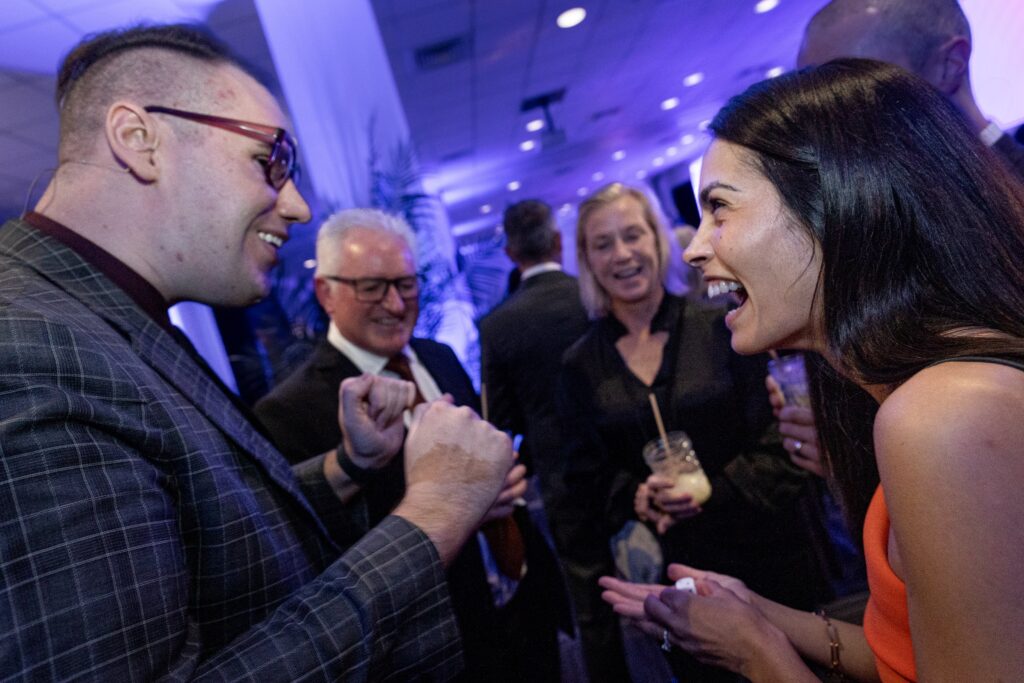
The rooms that come alive are the ones where something is happening during arrival. Cocktail magic and mindreading work here because they move. Small groups form, strangers end up in the same huddle, and people who came in with their own team end up talking to someone from another branch.
It is also where the names get learned. Brendan picks up the names of the guests he meets during this part of the night and carries them through the evening, which is why the awards later on feel like they are being hosted by someone who knows the room rather than someone reading off a card.
The practical benefit for the room is that by the time everyone sits down for dinner, the noise level is already up! A warm room at 7pm is a much easier room to run awards in at 9pm.
Other things that work in this window: a live musician playing under the conversation, a photo wall people actually want to use, or anything that gives guests a reason to move around rather than settle into a corner.
Get an MC who can host, not just read names
Plenty of companies host their own awards nights, and when the right person has the mic it can be great, because they know the people and the in-jokes. It is a big ask of someone who also has a table to sit at, though, and hosting is the part of the night with the most riding on it.
Hosting an awards night is its own particular job. It asks for different things than a conference does, and both are harder than they look from a table. The awards night MC needs to keep a long list of awards moving without it feeling like a queue. They need to give each winner a genuine moment. They need to fill the gaps when a winner is out of the room or the AV drops a slide. And they need to keep the energy of the room up across a couple of hours, without pulling focus from the people being recognised.
A few things worth briefing into whoever hosts:
- Keep the award intros short and specific. One sentence about why this person won beats a paragraph of category description.
- Plan the running order for energy, not alphabet. The biggest award goes late, but not so late that the room has emptied.
- Have a plan for a winner who is not there. A confident line and a move on. Dead air in the middle of an awards run is contagious.
- Protect the speeches. Two winners going long is usually what puts a night 20 minutes over.
An experienced host handles all of this without anyone noticing that it was handled, which is exactly the point.
What Brendan is actually watching for from the front of the room is who is up for being part of the night and who would rather just enjoy it, which tables have gone quiet, and when the room needs a laugh rather than another category. The cheeky stuff works because nobody is ever the butt of it, and the person who gets a gentle ribbing is the person who was clearly asking for one!
Awards tend to land better in blocks
Even a well-hosted awards run needs air in it. The two most common ways to give it that:
Split the awards around the dinner service. A block of awards between courses, then another block after dessert. It gives the room a natural breather and the kitchen a clear run.
Put entertainment between the blocks. A spot between award runs resets the room. People have been sitting and clapping for a while, and it gives them something to react to together rather than politely.
The reason a show spot works so well after an awards run is the shared experience. Everyone in the room watches the same thing at the same time, laughs at the same moments, and talks about it afterwards. That is what takes a night from “the awards were good” to “that night was great!”
Smaller awards nights need this more, not less
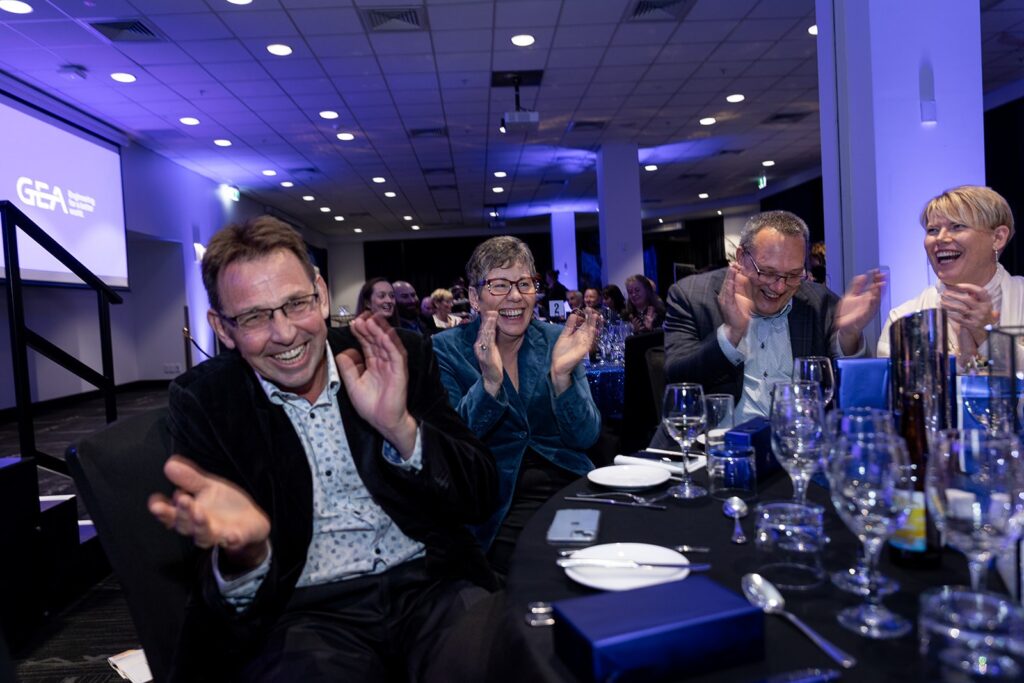
There is a common assumption that entertainment is something you add once the guest list gets big. It is usually the opposite.
A smaller awards night, say under 100 guests with a handful of awards, has a scheduling problem. The formal part might only run 30 or 40 minutes. Take away the speeches and the dinner service and there is not a lot of night left, which is how you end up with a room that empties at 9pm.
There is a second issue, and it is the one worth thinking hardest about. At an awards night, only a few people walk away with something. Everyone else came along, dressed up, sat through the categories and clapped for their colleagues. Without something else in the night, the evening belongs to the winners and everyone else is an audience for it.
That is exactly what entertainment fixes, and it is the reason a lot of companies book it: so everyone goes home having had a great night, not just the people holding trophies. Cocktail magic through the room means the people who are not collecting a trophy still get their own moment, up close, in their own hands. A show spot gives the whole room something they experienced together. Suddenly the night is not just an awards ceremony with dinner attached, it is an event in its own right, and the awards sit inside it as the highlight rather than the entire programme.
Smaller rooms also happen to be where this work is at its best. Under 100 guests, Brendan can meet most of the room during the cocktail magic, which means the hosting, the banter and the show later all come from someone who actually knows who he is talking to. That is much harder to do in a ballroom of 600!
What happens after the last award
The gap between the final trophy and the bar reopening is where a lot of awards nights quietly end. Guests who were going to stay decide to leave, and the room thins out.
Whatever fills that gap matters more than it looks. A band or DJ ready to start the moment the formalities finish. A dessert station that moves people out of their seats. An entertainer working the room again as people mingle. Anything that turns the end of the programme into the start of the social part of the night, rather than a full stop.
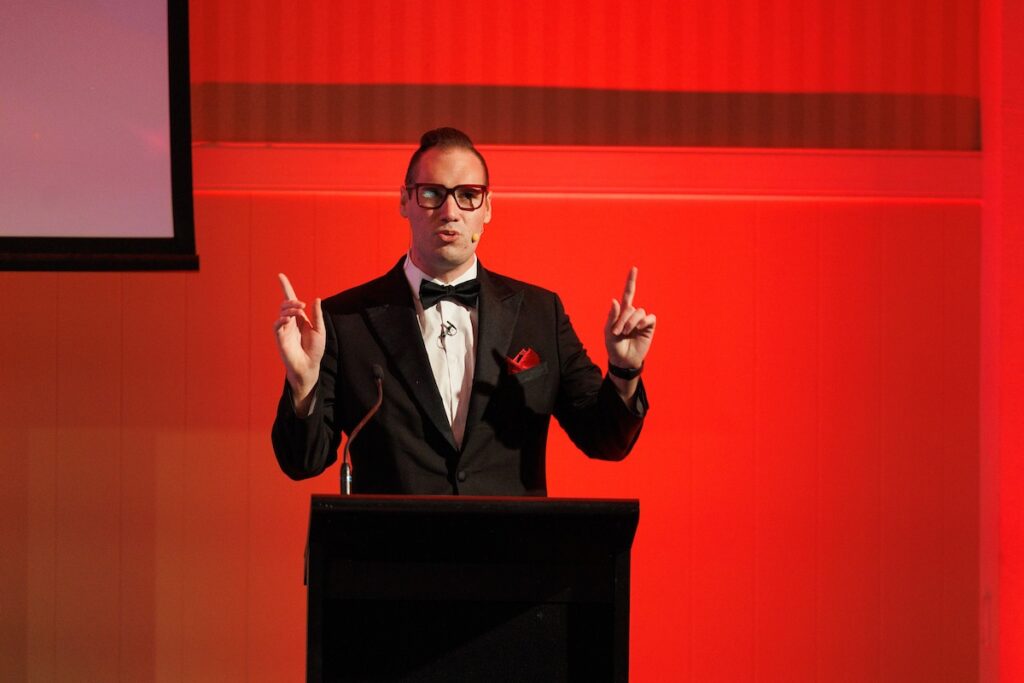
How a night like this tends to flow
Rather than one show dropped into the middle, most awards nights run better with the entertainment spread across the evening in shorter spots, sitting between the courses and the awards. It keeps lifting the room back up rather than asking it to hold its own energy for two hours.
A shape that works well:
| Part of the night | What is happening |
|---|---|
| Arrival | Drinks, cocktail magic and mindreading through the room, names being learned |
| Guests seated | A 10 to 20 minute opening spot with the welcome, the housekeeping and a proper warm up, so the room is together from the start |
| After entree | A 10 to 20 minute spot |
| First block of awards | The room is warm, so winners walk up to a crowd that is with them |
| After mains | Another 10 to 20 minute spot |
| Second block of awards | The bulk of the categories |
| Dessert | A shorter final spot to set up the finish |
| The big awards | The top awards, then the night handed back to the room and on to the bar or the dance floor |
None of this is fixed. The spots stretch or shrink, swap places or drop out entirely depending on the venue, the kitchen, how many awards there are and what the night needs on the day. The principle is the part worth keeping: entertainment spread through the night, awards in blocks rather than one long run, and the last stretch built around the people being recognised.
Run sheets change, and that is fine
Almost no awards night runs exactly as it was written. The kitchen is 20 minutes behind. A speech doubles in length. A winner is in the car park. Someone decides on the day that there is one more award to hand out, or the CEO wants to say a few words that were not in the plan.
This is where experience earns its keep. Spots get shortened, moved or dropped on the fly, the room gets held while the AV is sorted, and the night still reaches the big awards with the energy it needs. From the floor, nobody should be able to tell that anything changed.
It is why Brendan turns up with backup plans from B to Z! The programme on paper is the starting point, and the job is delivering the night the room actually needs on the day.
Five things that quietly take the air out of a night
- A programme with no gaps. Every minute filled means no room to breathe, and no recovery time when something runs long.
- AV as an afterthought. Every person in the room needs to hear clearly and see what is happening, and lighting does more for the energy of a room than most people expect. When the back tables cannot hear the winner’s name properly, they stop listening, and they are hard to win back.
- Entertainment booked to fill a slot. Anything booked because there was 20 minutes to fill, rather than because it does a job at that point in the night, tends to feel like it.
- Too many speeches. One heartfelt speech is a highlight. Four in a row is a lull.
- No one clearly in charge of the room. Someone needs to own the flow of the night and make the call when the run sheet slips. That is what an MC is for.
Frequently Asked Questions
Planning an awards night?
Brendan Dooley is an Auckland-based comedy magician, mentalist and MC who works awards nights, conferences and gala dinners across New Zealand and internationally, with 1,500+ shows in 15+ countries behind him, including headlining at the world famous Magic Castle in Hollywood and on luxury cruise lines worldwide.